
News

I am Yiren Lu (陆弈人), a third-year CS Ph.D. candidate at the VULab of Case Western Reserve University, where I have been conducting research under the supervision of Prof. Yu Yin since 2024.
Prior to that I received my M.S. in Computer Science and Engineering from University at Buffalo in 2024 under the supervision of Prof. Chen Wang and my B.Eng. degree in Computer Science from ShanghaiTech University in 2021 under the supervision of Prof. Sören Schwertfeger.
Warning
Problem: The current name of your GitHub Pages repository ("Solution: Please consider renaming the repository to "
http://".
However, if the current repository name is intended, you can ignore this message by removing "{% include widgets/debug_repo_name.html %}" in index.html.
Action required
Problem: The current root path of this site is "baseurl ("_config.yml.
Solution: Please set the
baseurl in _config.yml to "Education
-
Case Western Reserve University
 Visual Understanding Lab (VULab)
Ph.D. StudentJan. 2024 - present -
University at Buffalo

 Spatial AI and Robotics Lab (SAIR Lab)
M.S. in Computer ScienceSep. 2022 - Jan. 2024 -
ShanghaiTech University

 Mobile Autonomous Robotics Systems Lab
B.Eng. in Computer ScienceSep. 2017 - Jun. 2021
Experience
-
Uber
 AV Labs
Research Scientist InternMay. 2026 - Aug. 2026 -
Bosch Research North America
 Bosch Center for Artificial Intelligence
Research Scientist InternJun. 2025 - Dec. 2025 -
Tencent
 Interactive Entertainment Group (IEG)
Applied Scientist InternJuly. 2021 - Jun. 2022
Selected Publications (view all )
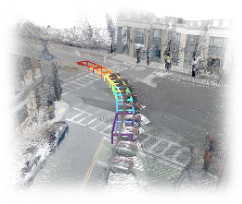
GeoWAM: Visual Geometry World Action Models for Autonomous Driving
Yiren Lu; Xin Ye; Jiaming Liu; Philip Jacobson; Jin Yao; Yi-chung Chen; Liam Merino; Dhruva Dixith Kurra; Min Cai; Tom Lampo; Yu Yin; Danhua Guo; Burhan Yaman.
arXiv preprint 2026
GeoWAM is a visual geometry world action model for autonomous driving that forecasts future 3D scene geometry, rather than future pixels, as its predictive objective. A geometry-conditioned action head then leverages these learned geometric dynamics to predict future ego trajectories, yielding substantially stronger driving policies than image-based world models.
GeoWAM: Visual Geometry World Action Models for Autonomous Driving
Yiren Lu; Xin Ye; Jiaming Liu; Philip Jacobson; Jin Yao; Yi-chung Chen; Liam Merino; Dhruva Dixith Kurra; Min Cai; Tom Lampo; Yu Yin; Danhua Guo; Burhan Yaman.
GeoWAM is a visual geometry world action model for autonomous driving that forecasts future 3D scene geometry, rather than future pixels, as its predictive objective. A geometry-conditioned action head then leverages these learned geometric dynamics to predict future ego trajectories, yielding substantially stronger driving policies than image-based world models.
Reconstruction Matters: Learning Geometry-Aligned BEV Representation through 3D Gaussian Splatting
Yiren Lu; Xin Ye; Burhaneddin Yaman; Jingru Luo; Zhexiao Xiong; Liu Ren; Yu Yin.
arXiv preprint 2026
We propose Splat2BEV, a Gaussian Splatting-assisted BEV framework that learns emantically rich and geometrically precise BEV feature representations.
Reconstruction Matters: Learning Geometry-Aligned BEV Representation through 3D Gaussian Splatting
Yiren Lu; Xin Ye; Burhaneddin Yaman; Jingru Luo; Zhexiao Xiong; Liu Ren; Yu Yin.
We propose Splat2BEV, a Gaussian Splatting-assisted BEV framework that learns emantically rich and geometrically precise BEV feature representations.
GSMem: 3D Gaussian Splatting as Persistent Spatial Memory for Zero-Shot Embodied Exploration and Reasoning
Yiren Lu; Yi Du; Disheng Liu; Yunlai Zhou; Chen Wang; Yu Yin.
arXiv preprint 2026
GSMem is a zero-shot embodied exploration and reasoning framework that utilize 3DGS as persistent memory.
GSMem: 3D Gaussian Splatting as Persistent Spatial Memory for Zero-Shot Embodied Exploration and Reasoning
Yiren Lu; Yi Du; Disheng Liu; Yunlai Zhou; Chen Wang; Yu Yin.
GSMem is a zero-shot embodied exploration and reasoning framework that utilize 3DGS as persistent memory.
Segment then Splat: Unified 3D Open-Vocabulary Segmentation via Gaussian Splatting
Yiren Lu; Yunlai Zhou; Yiran Qiao; Chaoda Song; Tuo Liang; Jing Ma; Yu Yin.
NeurIPS 2025
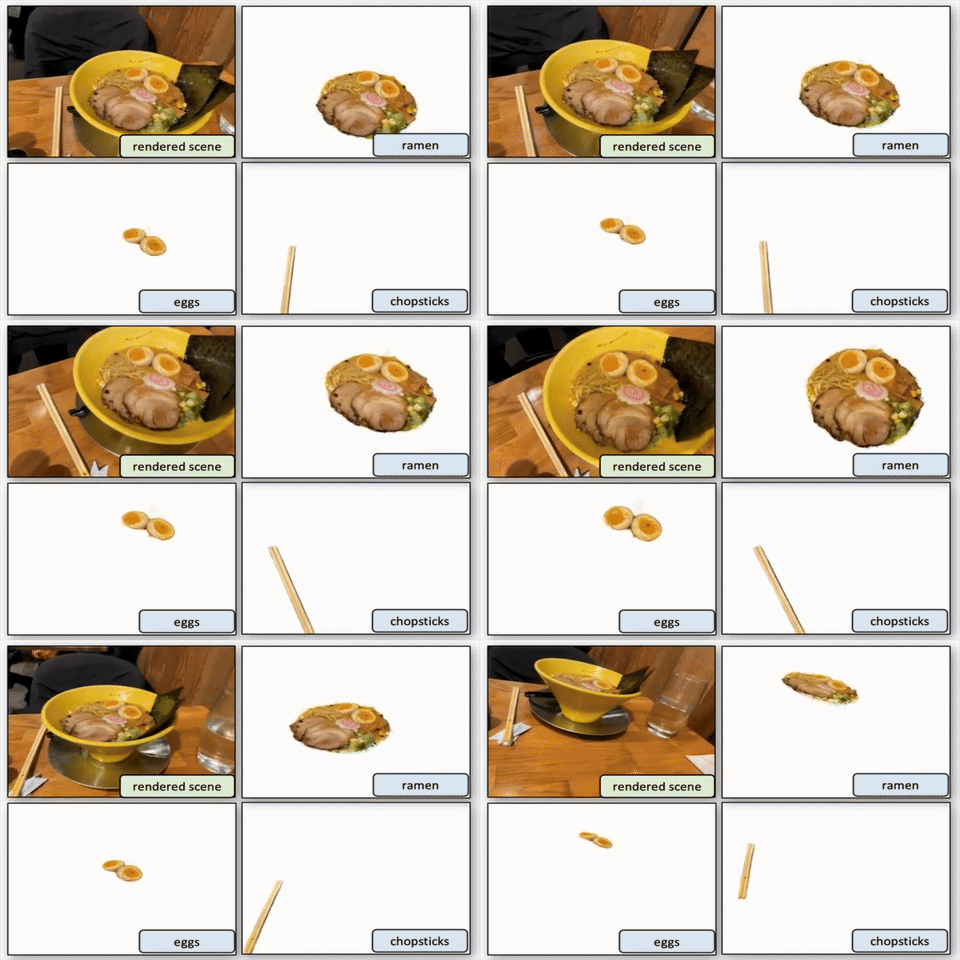
We propose Segment then Splat, which performs segmentation before reconstruction by dividing Gaussians into object sets upfront, eliminating semantic/geometric ambiguity and accelerating optimization.
Segment then Splat: Unified 3D Open-Vocabulary Segmentation via Gaussian Splatting
Yiren Lu; Yunlai Zhou; Yiran Qiao; Chaoda Song; Tuo Liang; Jing Ma; Yu Yin.
We propose Segment then Splat, which performs segmentation before reconstruction by dividing Gaussians into object sets upfront, eliminating semantic/geometric ambiguity and accelerating optimization.
Fix False Transparency by Noise Guided Splatting
Aly El Hakie*; Yiren Lu*; Yu Yin; Michael W. Jenkins; Yehe Liu. (* equal contribution)
NeurIPS 2025
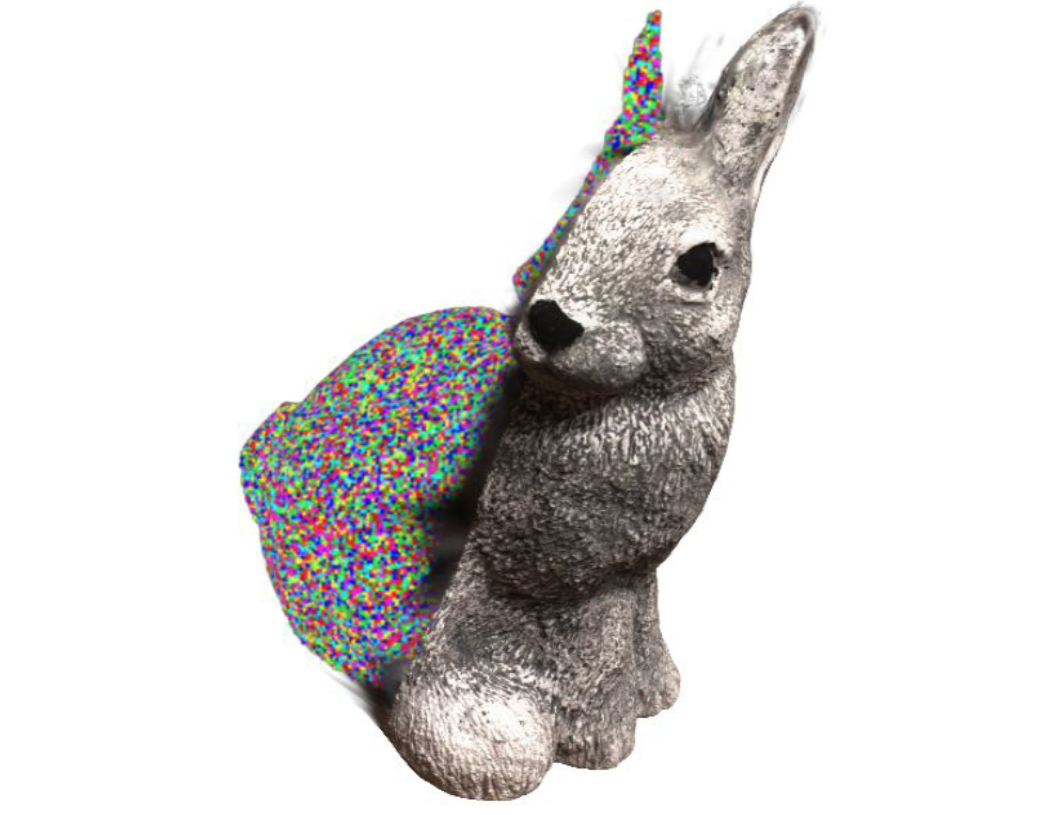
We propose Noise Guided Splatting to address false transparency artifacts in 3D Gaussian Splatting by injecting opaque noise Gaussians in object volumes during training.
Fix False Transparency by Noise Guided Splatting
Aly El Hakie*; Yiren Lu*; Yu Yin; Michael W. Jenkins; Yehe Liu. (* equal contribution)
We propose Noise Guided Splatting to address false transparency artifacts in 3D Gaussian Splatting by injecting opaque noise Gaussians in object volumes during training.
BARD-GS: Blur-Aware Reconstruction of Dynamic Scenes via Gaussian Splatting
Yiren Lu; Yunlai Zhou; Disheng Liu; Tuo Liang; Yu Yin.
CVPR 2025
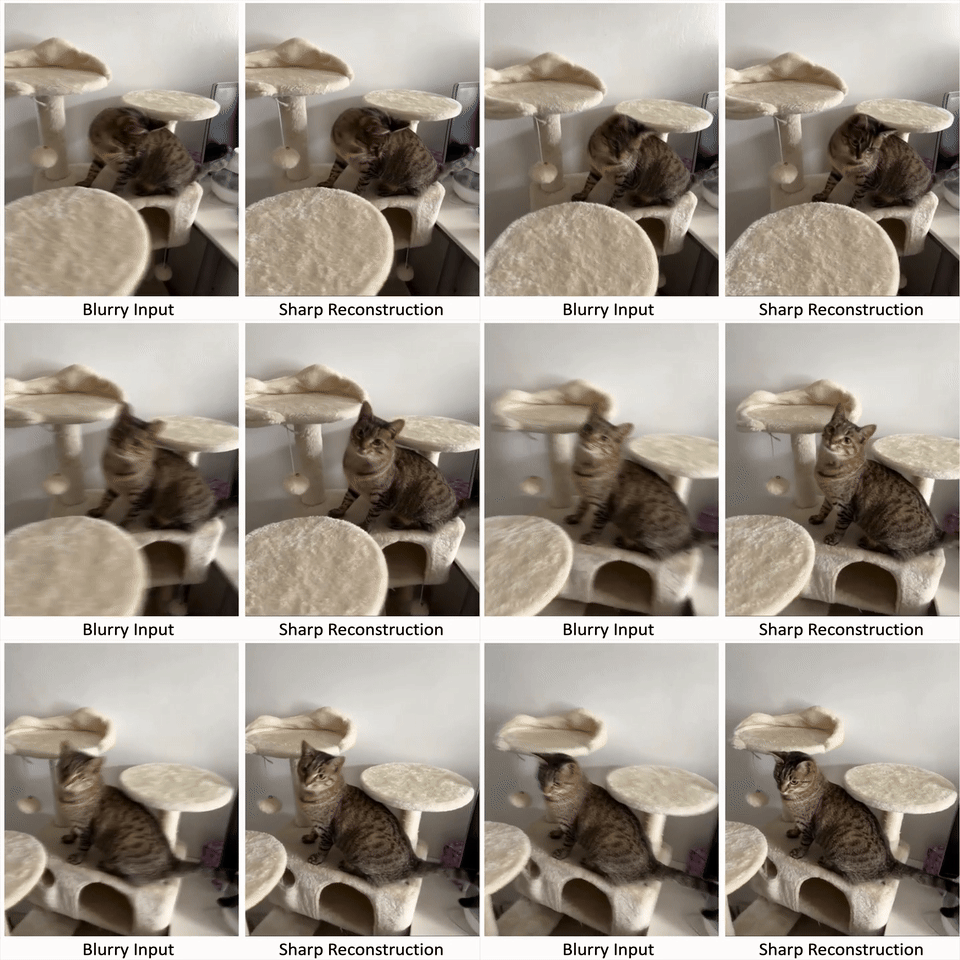
We introduce BARD-GS, a robust dynamic scene reconstruction method that explicitly decomposes motion blur into camera and object components to handle blurry inputs and imprecise camera poses.
BARD-GS: Blur-Aware Reconstruction of Dynamic Scenes via Gaussian Splatting
Yiren Lu; Yunlai Zhou; Disheng Liu; Tuo Liang; Yu Yin.
We introduce BARD-GS, a robust dynamic scene reconstruction method that explicitly decomposes motion blur into camera and object components to handle blurry inputs and imprecise camera poses.
View-consistent Object Removal in Radiance Fields
Yiren Lu; Jing Ma; Yu Yin.
ACM MM 2024
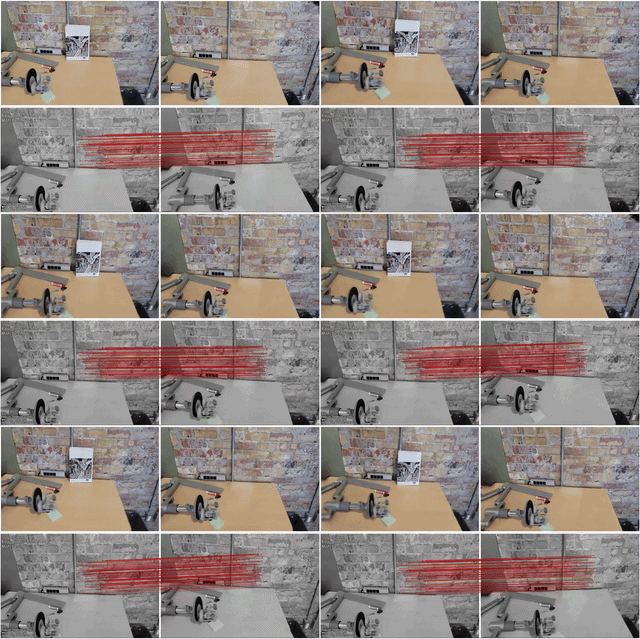
We introduce a novel radiance field editing pipeline that significantly enhances consistency by requiring inpainting of only a single reference image.
View-consistent Object Removal in Radiance Fields
Yiren Lu; Jing Ma; Yu Yin.
We introduce a novel radiance field editing pipeline that significantly enhances consistency by requiring inpainting of only a single reference image.
iSLAM: Imperative SLAM
Taimeng Fu; Shaoshu Su; Yiren Lu; Chen Wang.
Robotics and Automation Letters (RA-L) 2024
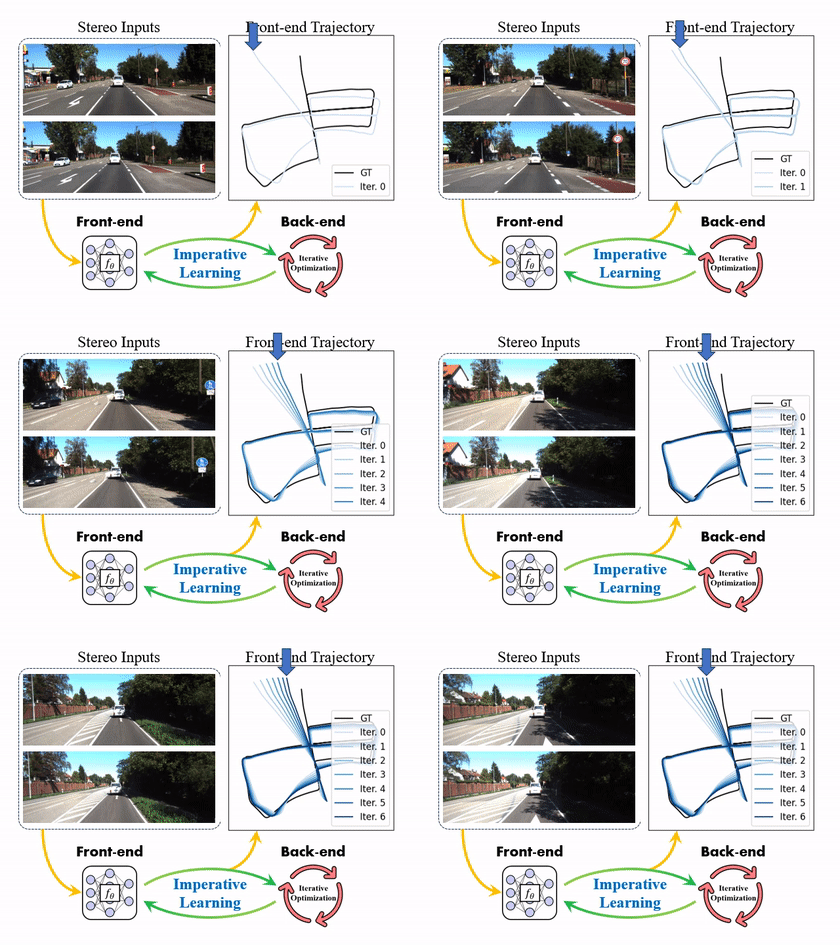
We proposed a novel self-supervised imperative learning framework, named imperative SLAM (iSLAM), which fosters reciprocal correction between the front-end and back-end and enhances performance without external supervision.
iSLAM: Imperative SLAM
Taimeng Fu; Shaoshu Su; Yiren Lu; Chen Wang.
We proposed a novel self-supervised imperative learning framework, named imperative SLAM (iSLAM), which fosters reciprocal correction between the front-end and back-end and enhances performance without external supervision.