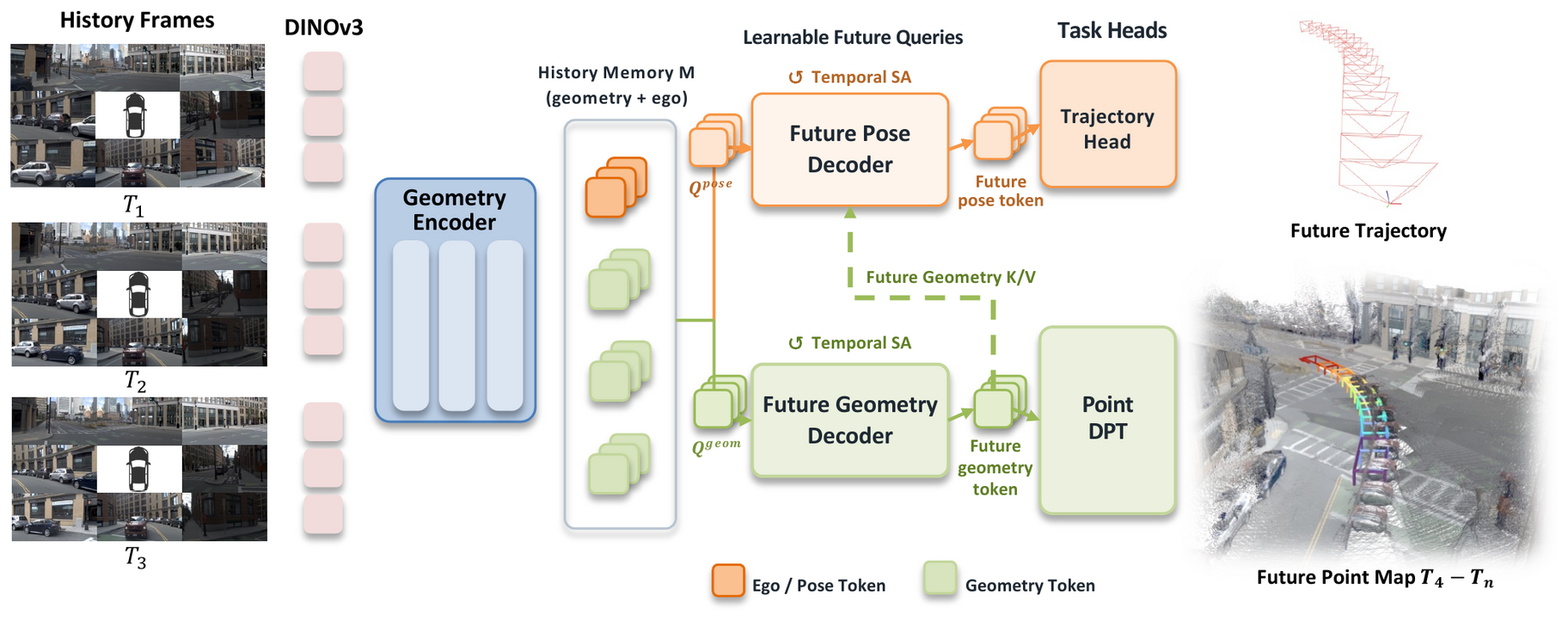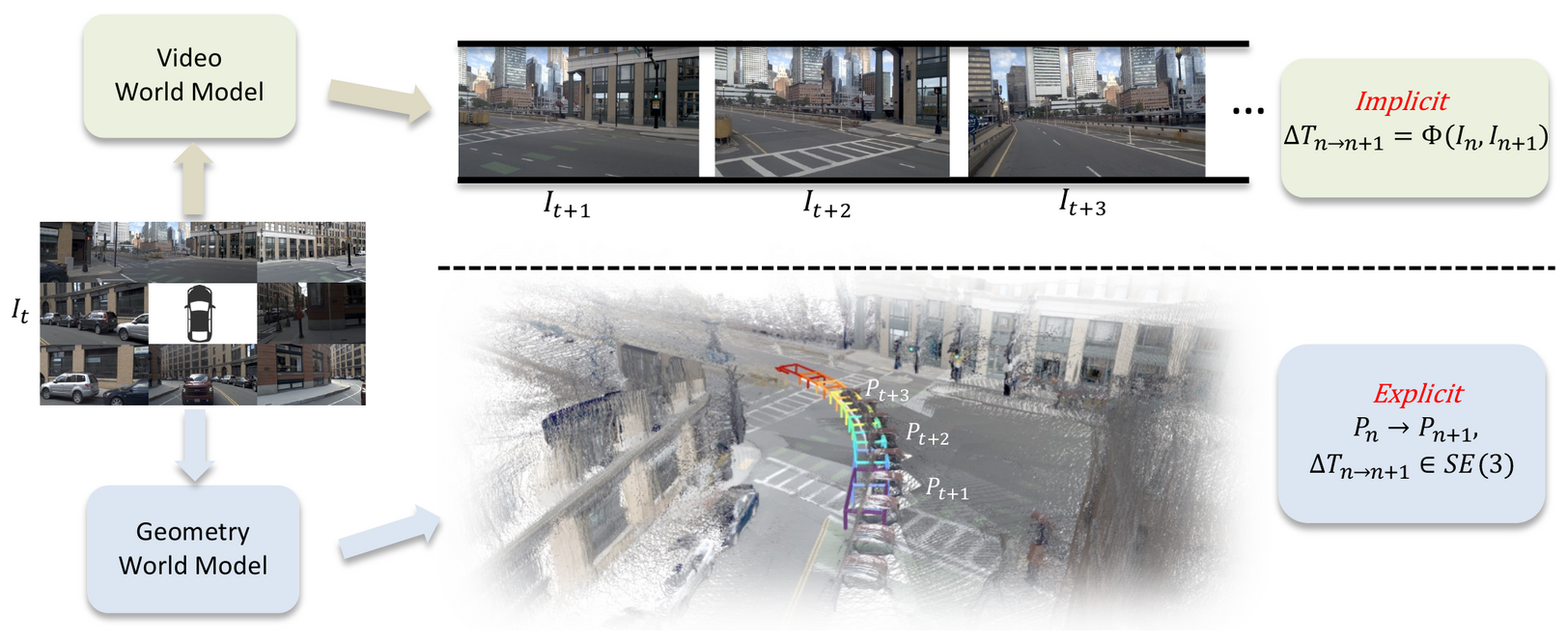
Stage 1 — Visual geometry world model. A geometry encoder maps the multiview image history into multi-level geometry tokens, which describe the spatial structure seen from each camera, and ego tokens, which carry ego-motion context. Together they form a history memory. A future geometry decoder starts from learned geometry queries that carry temporal, view, and 2D positional embeddings; causal temporal self-attention models how each spatial location evolves across the future steps, and cross-attention to the history memory retrieves the relevant observed context. A shared geometry head decodes the resulting features into a dense point map and a per-pixel confidence map for every future step. Supervision comes from cosine feature alignment against targets produced by the same encoder on the future frames (detached, and never given to the forecasting branch or used at inference), together with a dense point-map loss combining Euclidean regression, confidence-aware regression, and multi-scale surface-normal consistency, applied to both the future steps and the current frame.
Stage 2 — Geometry-conditioned action head. GeoWAM adopts an inverse-dynamics-like formulation: rather than regressing a trajectory directly, learned future ego queries cross-attend to both the history memory and the predicted future geometry to produce future ego tokens that encode the ego motion compatible with the forecast scene evolution. A stop-gradient on the predicted geometry keeps the trajectory loss from reshaping the pretrained forecasting capability. The action head refines the historical ego-token sequence with a causal temporal transformer, conditions a learnable trajectory query on the predicted future ego tokens, and regresses a single trajectory directly — with no trajectory anchors, mode classification, or iterative sampling.
We convert each predicted future point map to ray depth and report absolute relative error (Abs Rel, lower is better) and threshold accuracy δ < 1.25 (higher is better), at horizons from one to four seconds and averaged over all eight predicted frames. Video world models generate future RGB frames, so we reconstruct their geometry with DVGT to give every method a common geometric output.
| Method / Horizon | Abs Rel ↓ | δ < 1.25 ↑ | ||||||||
|---|---|---|---|---|---|---|---|---|---|---|
| 1s | 2s | 3s | 4s | mean | 1s | 2s | 3s | 4s | mean | |
| Epona + DVGT | 0.229 | 0.263 | 0.292 | 0.310 | 0.274 | 0.732 | 0.677 | 0.620 | 0.589 | 0.655 |
| Cosmos 3 + DVGT | 0.300 | 0.376 | 0.405 | 0.422 | 0.376 | 0.588 | 0.513 | 0.464 | 0.447 | 0.503 |
| VGGT-World | 0.272 | 0.329 | 0.342 | 0.357 | 0.325 | 0.612 | 0.553 | 0.513 | 0.497 | 0.544 |
| GeoWAM (ours) | 0.228 | 0.245 | 0.256 | 0.297 | 0.257 | 0.708 | 0.769 | 0.746 | 0.703 | 0.754 |
Future geometry prediction at different horizons. Bold and underlined values indicate the best and second-best results. GeoWAM attains the lowest Abs Rel at every horizon, improving the aggregate mean from 0.274 for the strongest baseline to 0.257, and lifts the mean δ < 1.25 from 0.655 to 0.754.
navtest
We finetune GeoWAM on the NAVSIM navtrain split and evaluate with the Extended Predictive Driver Model Score (EPDMS), which aggregates no at-fault collision (NC), drivable-area compliance (DAC), driving-direction compliance (DDC), traffic-light compliance (TLC), ego progress (EP), time-to-collision (TTC), lane keeping (LK), history comfort (HC), and extended comfort (EC). All metrics use the official human-penalty protocol; higher is better.
| Method | NC ↑ | DAC ↑ | DDC ↑ | TLC ↑ | EP ↑ | TTC ↑ | LK ↑ | HC ↑ | EC ↑ | EPDMS ↑ |
|---|---|---|---|---|---|---|---|---|---|---|
| Transfuser | 96.9 | 89.9 | 97.8 | 99.7 | 87.1 | 95.4 | 92.7 | 98.3 | 87.2 | 84.0 |
| Hydra-MDP++ | 97.2 | 97.5 | 99.4 | 99.6 | 83.1 | 96.5 | 94.4 | 98.2 | 70.9 | 81.4 |
| DriveSuprim | 97.5 | 96.5 | 99.4 | 99.6 | 88.4 | 96.6 | 95.5 | 98.3 | 77.0 | 83.1 |
| ARTEMIS | 98.3 | 95.1 | 98.6 | 99.8 | 81.5 | 97.4 | 96.5 | 98.3 | – | 83.1 |
| DiffusionDrive | 98.2 | 96.2 | 99.5 | 99.8 | 87.4 | 97.3 | 96.9 | 98.4 | 87.7 | 88.2 |
| WoTE | 98.5 | 96.8 | 98.8 | 99.8 | 86.1 | 97.9 | 95.5 | 98.3 | 82.9 | 87.7 |
| DriveVLA-W0 | 98.4 | 95.2 | 99.4 | 99.9 | 86.6 | 97.9 | 97.8 | 98.3 | 82.7 | 86.9 |
| PWM | 98.8 | 95.9 | 99.4 | 99.9 | 86.4 | 98.4 | 97.6 | 98.3 | 85.3 | 88.2 |
| DriveLaW | 98.7 | 96.9 | 99.6 | 99.8 | 87.5 | 98.3 | 97.6 | 98.4 | 77.4 | 88.6 |
| DVGT-2 | 98.7 | 97.9 | 99.7 | 99.9 | 87.9 | 98.0 | 98.2 | 98.2 | 77.0 | 89.6 |
| EponaV2 | 98.5 | 97.4 | 99.5 | 99.9 | 87.9 | 98.1 | 97.7 | 98.2 | 77.4 | 88.9 |
| GeoWAM (ours) | 98.7 | 97.7 | 99.7 | 99.9 | 87.0 | 98.1 | 97.9 | 98.3 | 86.8 | 90.2 |
Results on the NAVSIM v2 navtest split. GeoWAM reaches an EPDMS of 90.2, improving on its DVGT-2 initialization by 0.6 points and giving the best overall score in the table, while matching the best DDC and TLC and staying competitive on the remaining safety and progress components.
navhard
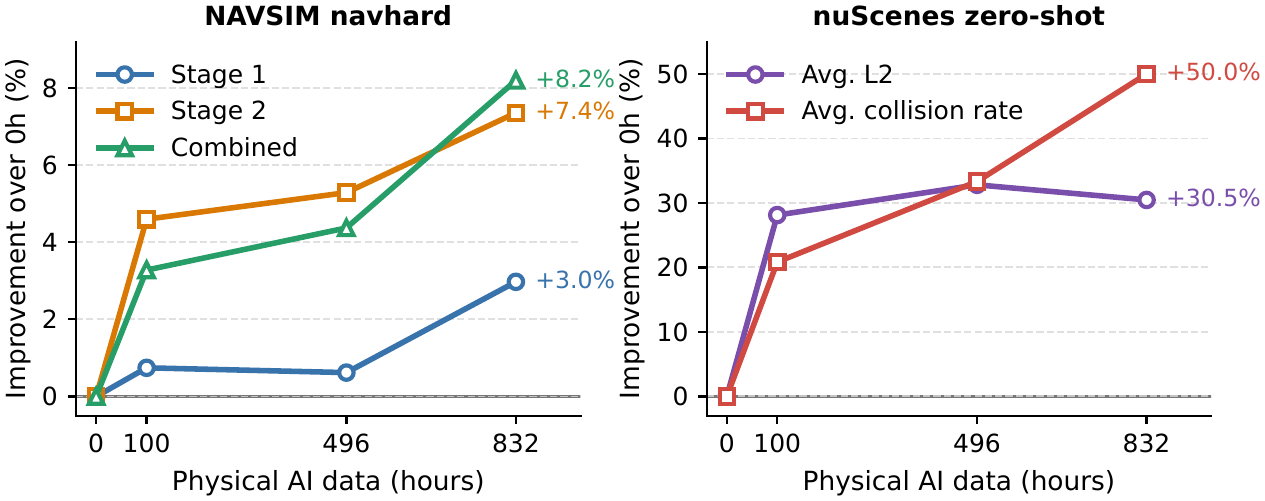
The navhard benchmark approximates closed-loop evaluation with scenes reconstructed by 3D Gaussian Splatting: after the planner predicts a trajectory, a new observation is rendered from the resulting ego pose and fed back for the next planning step, so planning errors propagate into subsequent observations. Stage 1 (S1) evaluates the original scenes and Stage 2 (S2) the synthetic reactive scenes.
| Method | Stage | NC ↑ | DAC ↑ | DDC ↑ | TLC ↑ | EP ↑ | TTC ↑ | LK ↑ | HC ↑ | EC ↑ | EPDMS ↑ |
|---|---|---|---|---|---|---|---|---|---|---|---|
| CV | S1 | 88.8 | 42.8 | 70.6 | 99.3 | 77.5 | 87.3 | 78.6 | 97.1 | 60.4 | 11.4 |
| S2 | 83.2 | 59.1 | 76.5 | 98.0 | 71.3 | 81.1 | 47.9 | 97.1 | 61.9 | ||
| Ego MLP | S1 | 93.2 | 55.7 | 86.6 | 99.3 | 81.2 | 92.2 | 83.5 | 97.5 | 77.7 | 14.1 |
| S2 | 77.2 | 51.9 | 74.4 | 98.2 | 77.1 | 75.0 | 40.8 | 97.8 | 79.8 | ||
| LTF | S1 | 96.2 | 79.5 | 99.1 | 99.5 | 84.1 | 95.1 | 94.2 | 97.5 | 79.1 | 25.1 |
| S2 | 77.7 | 70.2 | 84.2 | 98.0 | 85.1 | 75.6 | 45.4 | 95.7 | 75.9 | ||
| DriveVLA-W0 | S1 | 96.8 | 83.3 | 99.0 | 99.6 | 84.6 | 95.3 | 96.4 | 97.6 | 78.2 | 24.4 |
| S2 | 76.8 | 64.3 | 79.9 | 98.3 | 89.2 | 75.0 | 46.8 | 95.8 | 53.1 | ||
| DriveLaW | S1 | 97.3 | 89.1 | 99.2 | 99.6 | 84.3 | 97.1 | 96.2 | 97.8 | 67.6 | 30.6 |
| S2 | 82.5 | 67.6 | 83.5 | 98.1 | 84.8 | 78.5 | 45.8 | 96.4 | 57.3 | ||
| DVGT-2 | S1 | 97.2 | 91.3 | 98.4 | 99.8 | 84.8 | 95.5 | 95.5 | 97.5 | 71.4 | 31.7 |
| S2 | 77.8 | 73.8 | 81.3 | 98.3 | 91.5 | 73.2 | 48.0 | 83.9 | 45.1 | ||
| LTFv6† | S1 | 96.5 | 86.6 | 99.2 | 99.5 | 84.4 | 95.1 | 94.4 | 97.7 | 76.4 | 31.9 |
| S2 | 79.8 | 75.5 | 86.2 | 97.8 | 89.5 | 76.0 | 50.0 | 95.2 | 66.7 | ||
| NavFormer† | S1 | 96.2 | 92.4 | 95.7 | 99.6 | 83.8 | 96.0 | 94.7 | 96.4 | 60.9 | 34.1 |
| S2 | 85.7 | 81.0 | 83.5 | 97.6 | 90.1 | 82.4 | 48.2 | 94.9 | 48.4 | ||
| EponaV2† | S1 | 97.3 | 90.7 | 99.4 | 100.0 | 83.3 | 97.3 | 97.3 | 97.6 | 60.9 | 36.1 |
| S2 | 83.6 | 78.0 | 88.0 | 98.9 | 86.0 | 80.3 | 50.1 | 96.1 | 52.0 | ||
| GeoWAM (ours) | S1 | 97.7 | 91.5 | 99.1 | 99.8 | 83.8 | 95.8 | 96.0 | 97.8 | 79.0 | 36.6 |
| S2 | 80.4 | 76.3 | 87.3 | 98.7 | 88.9 | 76.2 | 49.9 | 94.0 | 56.0 |
navhard leaderboard. Methods trained with reinforcement learning or PDMS-score supervision are shown in gray and marked with †; among the remaining methods, bold and underlined values indicate the best and second-best results. GeoWAM reaches an EPDMS of 36.6, outperforming all baselines including those trained with score supervision.
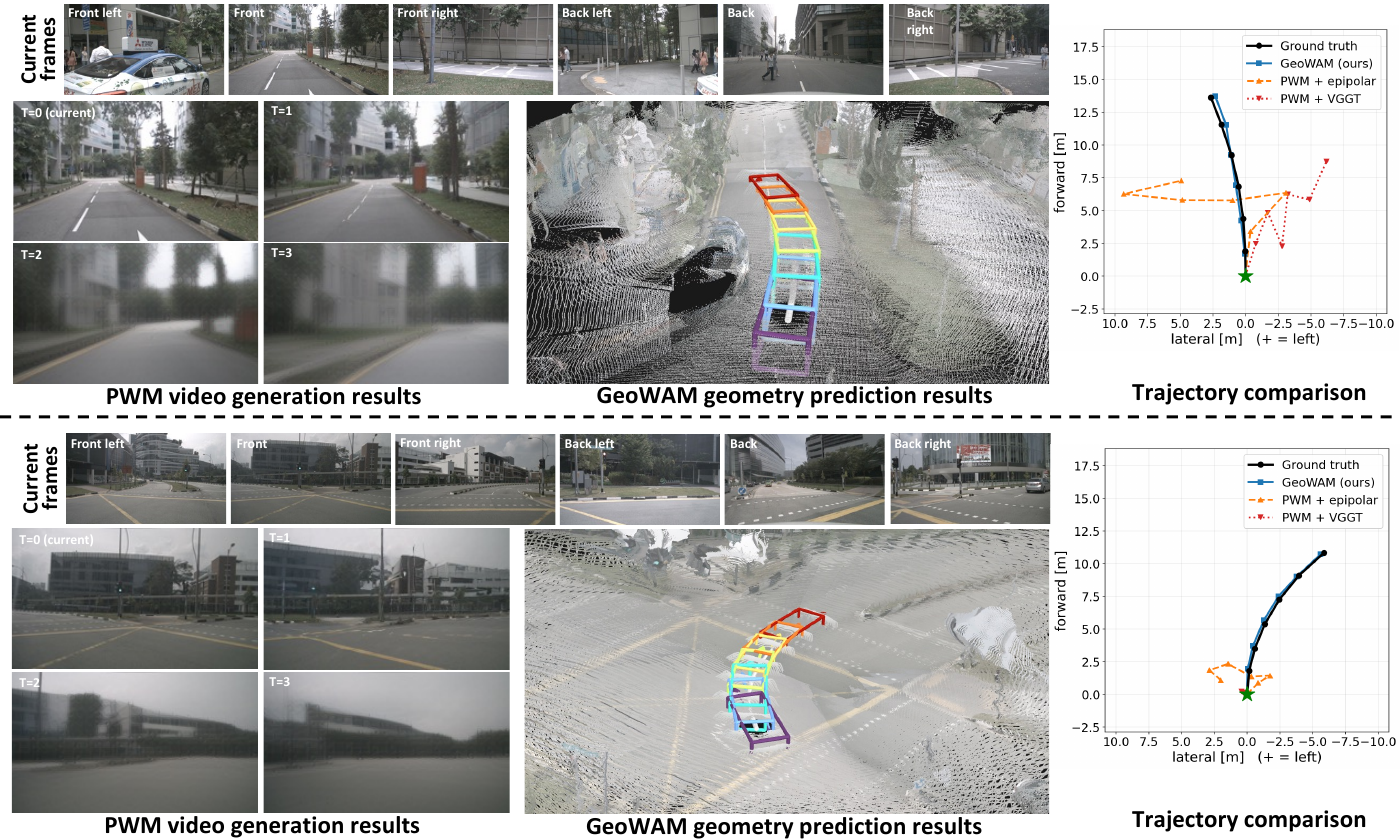
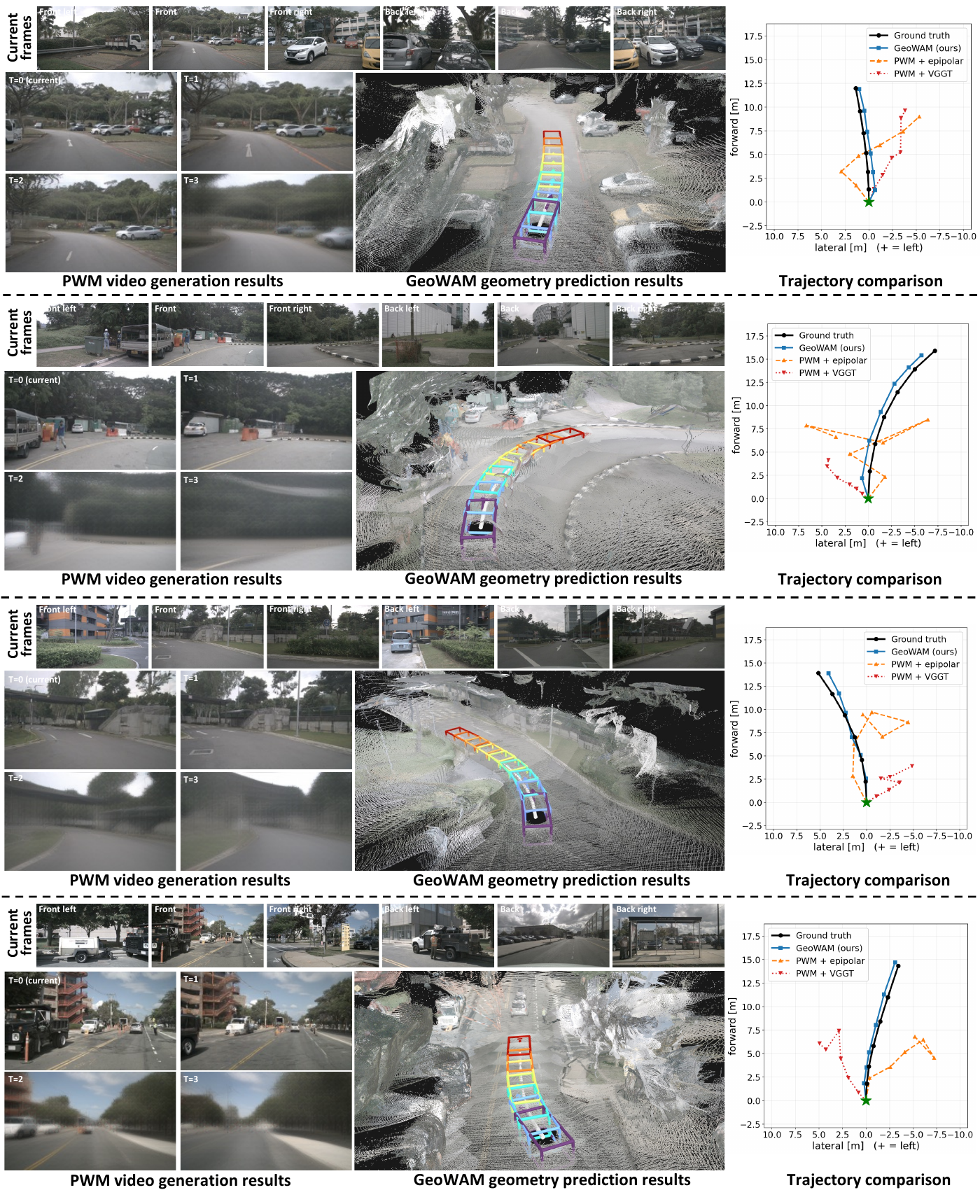
For three representative maneuvers — turning left, driving straight, and turning right — we aggregate the predicted geometry from all future time steps into a single visualization, with bounding boxes marking the predicted ego poses at successive steps. Across all three, GeoWAM preserves coherent scene structure over the prediction horizon and reconstructs environmental elements such as trees and poles as well as fine-grained road markings. In the left-turn case, another vehicle follows the ego vehicle through the turn in the predicted future geometry, showing that GeoWAM captures the dynamics of surrounding agents and not only ego motion. In the straight-driving case, the predicted trajectory steers around a vehicle along the roadside, showing that the forecast geometry provides actionable spatial context for planning.
If you find our work helpful, please consider cite us:
@misc{lu2026geowam,
title={GeoWAM: Visual Geometry World Action Models for Autonomous Driving},
author={Yiren Lu and Xin Ye and Jiaming Liu and Philip Jacobson and Jin Yao and Yi-chung Chen and Liam Merino and Dhruva Dixith Kurra and Min Cai and Tom Lampo and Yu Yin and Danhua Guo and Burhan Yaman},
year={2026},
eprint={2608.23486},
archivePrefix={arXiv},
primaryClass={cs.CV},
url={https://arxiv.org/abs/2608.23486},
}